---
title: Multi-Tenant Research Facility Management | Part 2
description: Explore 5 key questions about managing multi-tenant research facilities, from shared lab spaces and equipment to maintenance and communication.
image: https://ifm.flagshipinc.com/hubfs/04-Blog/lab-research-facility.jpg
---
[](https://flagshipinc.com/)
Search Site
Search Site
- [Services](https://flagshipinc.com/services/)
- [Facility Maintenance](https://flagshipinc.com/facility-maintenance/)
- [Specialty Maintenance](https://flagshipinc.com/specialty-maintenance/)
- [Janitorial Services](https://flagshipinc.com/janitorial-services/)
- [Engineering Services](https://flagshipinc.com/engineering-services/)
- [Managed IT Services](https://flagshipinc.com/managed-it-services/)
- [Mechanical/Electrical/Plumbing (MEP)](https://flagshipinc.com/mechanical-electrical-plumbing/)
- [Lab Support Services](https://flagshipinc.com/lab-support-services/)
- [Lab Equipment Services](https://flagshipinc.com/lab-equipment-services/)
- [Culinary Services](https://flagshipinc.com/culinary-services/)
- [Project Management](https://flagshipinc.com/project-management/)
- [Ancillary Staff Management](https://flagshipinc.com/ancillary-staff-management/)
- [Mobile Support](https://flagshipinc.com/mobile-support/)
- [Industries](https://flagshipinc.com/industries/)
- [Aviation](https://flagshipinc.com/industries/aviation/)
- [Business & Manufacturing](https://flagshipinc.com/industries/business-manufacturing/)
- [High Tech](https://flagshipinc.com/industries/high-tech/)
- [Life Sciences](https://flagshipinc.com/industries/life-sciences/)
- [Education](https://flagshipinc.com/industries/education/)
- [Jobs](https://flagshipinc.com/jobs/)
- [Applying to a Job](https://flagshipinc.com/jobs/apply-to-a-job/)
- [Jobs Listings](https://flagshipinc.wd5.myworkdayjobs.com/flagshipinc)
- [Resources](https://flagshipinc.com/resources/)
- [Newsroom](https://flagshipinc.com/resources/newsroom/)
- [Inside FM Blog](https://ifm.flagshipinc.com/)
- [Webinar](https://flagshipinc.com/resources/webinars/)
- [Videos](https://flagshipinc.com/resources/videos/)
- [Client Stories](https://flagshipinc.com/resources/client-stories/)
- [White Papers](https://flagshipinc.com/resources/white-papers/)
- [Library](https://flagshipinc.com/category/library/)
- [About](https://flagshipinc.com/about/)
- [Leadership](https://flagshipinc.com/about/leadership/)
- [Volunteer & Outreach](https://flagshipinc.com/about/volunteer-outreach/)
- [Locations](https://flagshipinc.com/about/locations/)
- [Values](https://flagshipinc.com/about/values/)
- [Safety](https://flagshipinc.com/about/safety/)
- [Inclusion & Diversity](https://flagshipinc.com/about/inclusion-diversity/)
- [Contact Us](https://flagshipinc.com/contact/)
- [IT Customer Portal](https://flagshipinc.myportallogin.com/)
- [Lab Equipment Service Request](https://flagshipinc.com/lab-equipment-service-request/)
- [Scope of Work](https://flagshipinc.com/contact/scope-of-work/)
- [We're Social](https://flagshipinc.com/contact/social/)
- [Talk to an Expert](https://flagshipinc.com/contact/)
# Managing Multi-Tenant Research Facilities: 5 Questions Answered | Part 2
Category: [Life Sciences](https://ifm.flagshipinc.com/tag/life-sciences)
Tags: [Lab Support Services](https://flagshipinc.com/category/lab-support-services/)
Multi-Tenant Research Facility Management | Part 2
8:25
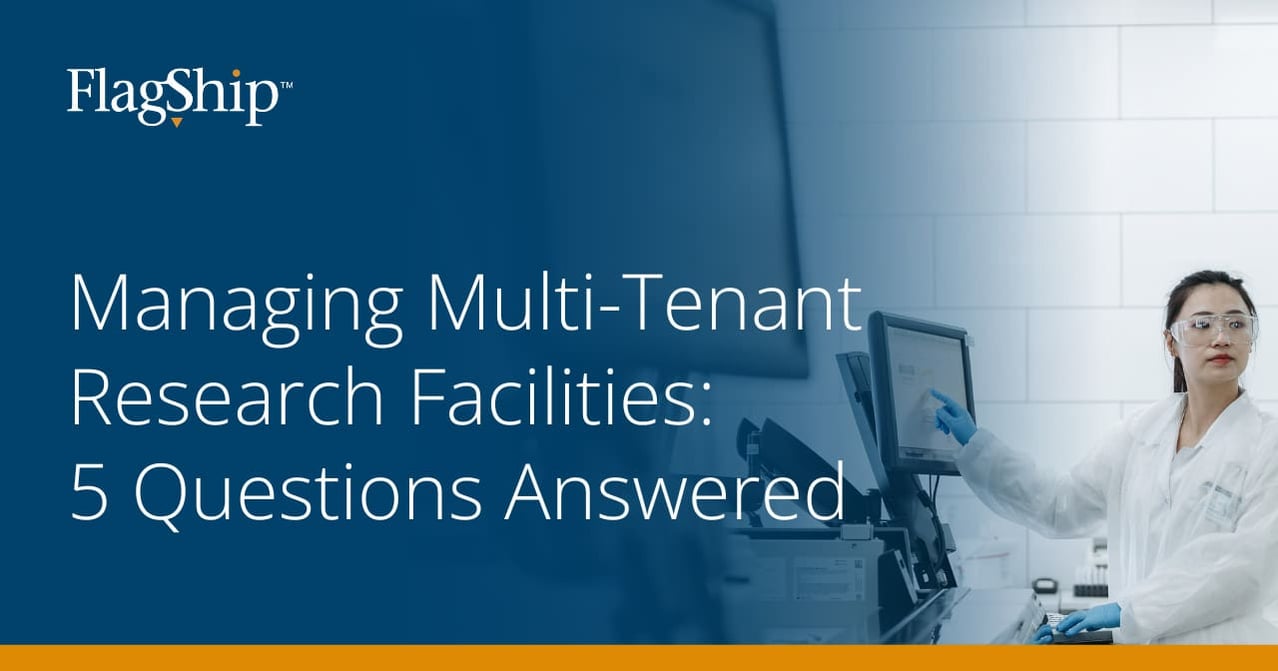
*This is* ***Part 2 of our two-part FAQ series*** *on managing multi-tenant research facilities. Catch up on* **[*Part 1*](https://ifm.flagshipinc.com/multi-tenant-research-facility-management-flagship)***, then continue below as we answer five more questions about navigating the complexities of a shared research environment.*
Managing a multi-tenant research facility requires attention to more than what happens within individual lab spaces. Deliveries, critical equipment, building infrastructure, communication, and tenant transitions often cross organizational boundaries, creating dependencies that can be easy to overlook.
For property teams, those intersections matter. A delayed shipment, planned shutdown, unclear handoff, or change in occupancy can have far-reaching effects, especially when multiple research organizations rely on the same spaces, systems, and services.
In Part 2, we’re taking a closer look at **five operational areas where thoughtful planning and coordination can help keep the entire facility running smoothly.**
## 6. Why is the loading dock a critical part of research operations?
Because the dock is often where the outside supply chain meets the lab.
A multi-tenant research facility may receive routine supplies alongside specialized equipment, temperature-sensitive materials, chemicals, samples, gases, and other research-related shipments. Some tenants may even generate outgoing materials and waste streams.
All of that activity can converge on the same dock. The operational challenge extends beyond receiving packages. Property teams have to consider the movement of materials from end to end:
**Arrival → verification → staging → internal transport → tenant handoff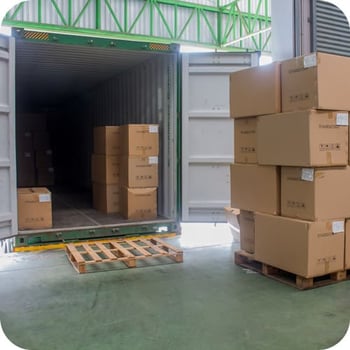**
Incoming materials may require specialized handling or prompt delivery, while some vendors need controlled access to the facility. Freight elevator use requires coordination, and large equipment deliveries benefit from advance planning. Outgoing materials can introduce a separate set of handling and transport protocols.
Looking at the dock as part of the research workflow, rather than simply a receiving area, can reveal bottlenecks and handoff risks that might otherwise go unnoticed.
## 7. How can property teams prevent communication gaps between multiple research tenants?
In a busy research property, sending every update to everyone can make it harder for tenants to distinguish routine information from something that requires immediate action.
A more effective approach is to create communication tiers based on operational impact.
For example:
**Routine:** General service updates, scheduled activities, and non-urgent notices
**Operational:** Issues affecting deliveries, access, utilities, equipment support, or lab workflows
**Critical:** Events requiring immediate attention because they may affect safety, sensitive materials, research continuity, or critical infrastructure
Each tier should have defined recipients, communication channels, response expectations, and escalation paths.
Research environments already use formal escalation processes to distinguish routine corrective actions from conditions requiring more immediate intervention. The same principle can strengthen day-to-day facility communication.
***Your Research Depends on Your Equipment***
*Give researchers confidence in the equipment they rely on with specialized maintenance, repair, calibration, and asset management services.*
***Explore Lab Equipment Services → [Flagship Solutions](https://flagshipinc.com/lab-equipment-services/)***
## 8. What makes tenant turnover more complicated in lab properties?
A [lab transition](https://ehs.utexas.edu/research-labs-clinical/lab-evaluations-and-ut-herd) involves considerably more than handing over keys and preparing the suite for a new occupant.
Depending on the work previously performed, a [move-out](https://www.ehs.harvard.edu/resource/lab-move-form) can involve:
- Equipment decommissioning
- Material removal
- Specialized cleaning or decontamination
- Waste coordination
- Documentation
- Utility changes
- Verification that the space is ready for its next use
For property managers, the takeaway is important: treat tenant turnover as an operational readiness project, not solely as a leasing event.
Planning should begin early to clarify the outgoing tenant’s responsibilities, the property team’s verification requirements, and what the incoming organization needs to begin research.
## 9. How can property teams identify facility risks before they interrupt research?
One approach is to map dependencies rather than look only at assets. An asset register might tell a facilities team which equipment or building systems exist. A dependency map asks a different question:
**What happens if this system becomes unavailable?**
Property teams can work with tenants to identify dependencies such as:
- Critical utilities
- Temperature-controlled storage
- Sensitive equipment
- Restricted areas
- Essential delivery windows
- Backup requirements
- Activities affected by planned shutdowns
This doesn't require tenants to disclose confidential research.
The goal is operational awareness. If the property team knows that a particular utility supports sensitive equipment or that certain deliveries can't tolerate extended staging, it can plan maintenance, escalation, and contingency procedures accordingly.
That's a more useful view of risk than treating every asset failure as though it carries the same consequence.
## 10. What does effective multi-tenant research facility management look like?
Effective management creates enough consistency to operate the property efficiently while preserving enough flexibility to support different research environments.
A useful framework is to evaluate five areas: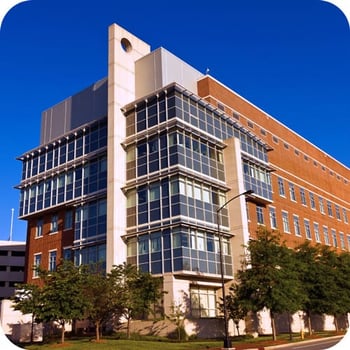
**Dependencies:** Which research activities rely on critical building systems, equipment, or services?
**Responsibilities:** Where do property, tenant, and service-provider responsibilities begin and end?
**Impacts:** Which routine facility activities could interfere with tenant operations?
**Movement:** How do people, materials, equipment, deliveries, and waste travel through shared environments?
**Escalation:** How does important information reach the right person when conditions change?
Shared research environments particularly benefit from clearly assigned responsibility. Research guidance for shared labs emphasizes designated points of responsibility, while studies of centralized shared-equipment programs show how dedicated management can reduce administrative burdens and make shared resources easier for researchers to use.
For property teams, that points to a broader principle: the building should be managed as an interconnected research environment, not simply a collection of individual tenant suites.
## Bringing the Pieces Together
In a multi-tenant research facility, a lot happens between the front door and the bench.
Deliveries, building systems, maintenance schedules, communication, and tenant transitions all intersect with the research taking place throughout the property. Because these activities rarely occur in isolation, a change in one area can create downstream effects for individual tenants, shared spaces, or the facility as a whole.
Those connections give property teams an opportunity to improve how the facility operates. Looking beyond individual work orders and [assets](https://www.labmanager.com/a-better-way-to-manage-lab-assets-across-sites-35659) to understand dependencies, responsibilities, and potential impacts can help teams identify issues earlier and coordinate services around the needs of the research environment.
**Explore how [Flagship Lab Services](https://flagshipinc.com/industries/life-sciences/) can help support your multi-tenant research facility.**
## Leave a Comment
### Subscribe Now! Stay up to date with the latest facility management tips and news.
## More Resources
[](https://ifm.flagshipinc.com/multi-tenant-research-facility-management-part2)
### [Managing Multi-Tenant Research Facilities: 5 Questions Answered | Part 2](https://ifm.flagshipinc.com/multi-tenant-research-facility-management-part2)
[](https://ifm.flagshipinc.com/lab-productivity-automated-calibration-systems)
### [Maximizing Lab Productivity with Automated Calibration Systems](https://ifm.flagshipinc.com/lab-productivity-automated-calibration-systems)
[](https://ifm.flagshipinc.com/iq-oq-pq-validation-what-to-know)
### [IQ, OQ, and PQ Validation: What You Need to Know](https://ifm.flagshipinc.com/iq-oq-pq-validation-what-to-know)
## Sign Up for Our Inside FM Blog

### [Services](https://flagshipinc.com/services/)
- [Facility Maintenance](https://flagshipinc.com/facility-maintenance/)
- [Janitorial Services](https://flagshipinc.com/janitorial-services/)
- [Lab Support Services](https://flagshipinc.com/lab-support-services/)
- [Managed IT Services](https://flagshipinc.com/managed-it-services/)
- [Culinary Services](https://flagshipinc.com/culinary-services/)
### Helpful Links
- [Job Listings](https://flagshipinc.wd5.myworkdayjobs.com/flagshipinc)
- [Request Scope of Work](https://flagshipinc.com/contact/scope-of-work/)
- [IT Customer Portal](https://flagshipinc.myportallogin.com/)
- [Flagship Culinary Services](https://flagshipculinaryservices.com/)
### Contact Us
[844-649-8884](tel:844-649-8884)
[info@FlagshipInc.com](mailto:info@flagshipinc.com)
Headquarters
[405 S Kimball Ave, Southlake, TX 76092](https://goo.gl/maps/ESpSET66qQ9zLzsS9)
© 2024 [Flagship Facility Services](https://flagshipinc.com) | [Privacy Policy](https://flagshipinc.com/privacy-policy/)
```json
{
"@context" : "https://schema.org",
"@id" : "https://ifm.flagshipinc.com/#organization",
"@type" : "Organization",
"logo" : "https://4850175.fs1.hubspotusercontent-na1.net/hubfs/4850175/Flagship-Facility-Services-F-Logo.jpg",
"name" : "Flagship Facility Services, Inc.",
"sameAs" : [ "https://www.facebook.com/FlagshipFacilityServices", "https://www.linkedin.com/company/flagship-facility-services-inc/", "https://www.youtube.com/channel/UCUZ_pkCHvdKTPr7htFIZkgg", "https://twitter.com/Flagship_Inc" ],
"url" : "https://ifm.flagshipinc.com/"
}
```
```json
{
"@context" : "http://schema.org",
"@type" : "BlogPosting",
"articleBody" : "This is Part 2 of our two-part FAQ series on managing multi-tenant research facilities. Catch up on Part 1, then continue below as we answer five more questions about navigating the complexities of a shared research environment. Managing a multi-tenant research facility requires attention to more than what happens within individual lab spaces. Deliveries, critical equipment, building infrastructure, communication, and tenant transitions often cross organizational boundaries, creating dependencies that can be easy to overlook. For property teams, those intersections matter. A delayed shipment, planned shutdown, unclear handoff, or change in occupancy can have far-reaching effects, especially when multiple research organizations rely on the same spaces, systems, and services. In Part 2, were taking a closer look at five operational areas where thoughtful planning and coordination can help keep the entire facility running smoothly. 6. Why is the loading dock a critical part of research operations? Because the dock is often where the outside supply chain meets the lab. A multi-tenant research facility may receive routine supplies alongside specialized equipment, temperature-sensitive materials, chemicals, samples, gases, and other research-related shipments. Some tenants may even generate outgoing materials and waste streams. All of that activity can converge on the same dock. The operational challenge extends beyond receiving packages. Property teams have to consider the movement of materials from end to end: Arrival → verification → staging → internal transport → tenant handoff Incoming materials may require specialized handling or prompt delivery, while some vendors need controlled access to the facility. Freight elevator use requires coordination, and large equipment deliveries benefit from advance planning. Outgoing materials can introduce a separate set of handling and transport protocols. Looking at the dock as part of the research workflow, rather than simply a receiving area, can reveal bottlenecks and handoff risks that might otherwise go unnoticed. 7. How can property teams prevent communication gaps between multiple research tenants? In a busy research property, sending every update to everyone can make it harder for tenants to distinguish routine information from something that requires immediate action. A more effective approach is to create communication tiers based on operational impact. For example: Routine: General service updates, scheduled activities, and non-urgent notices Operational: Issues affecting deliveries, access, utilities, equipment support, or lab workflows Critical: Events requiring immediate attention because they may affect safety, sensitive materials, research continuity, or critical infrastructure Each tier should have defined recipients, communication channels, response expectations, and escalation paths. Research environments already use formal escalation processes to distinguish routine corrective actions from conditions requiring more immediate intervention. The same principle can strengthen day-to-day facility communication. Your Research Depends on Your Equipment Give researchers confidence in the equipment they rely on with specialized maintenance, repair, calibration, and asset management services. Explore Lab Equipment Services → Flagship Solutions 8. What makes tenant turnover more complicated in lab properties? A lab transition involves considerably more than handing over keys and preparing the suite for a new occupant. Depending on the work previously performed, a move-out can involve: Equipment decommissioning Material removal Specialized cleaning or decontamination Waste coordination Documentation Utility changes Verification that the space is ready for its next use For property managers, the takeaway is important: treat tenant turnover as an operational readiness project, not solely as a leasing event. Planning should begin early to clarify the outgoing tenants responsibilities, the property teams verification requirements, and what the incoming organization needs to begin research. 9. How can property teams identify facility risks before they interrupt research? One approach is to map dependencies rather than look only at assets. An asset register might tell a facilities team which equipment or building systems exist. A dependency map asks a different question: What happens if this system becomes unavailable? Property teams can work with tenants to identify dependencies such as: Critical utilities Temperature-controlled storage Sensitive equipment Restricted areas Essential delivery windows Backup requirements Activities affected by planned shutdowns This doesn't require tenants to disclose confidential research. The goal is operational awareness. If the property team knows that a particular utility supports sensitive equipment or that certain deliveries can't tolerate extended staging, it can plan maintenance, escalation, and contingency procedures accordingly. That's a more useful view of risk than treating every asset failure as though it carries the same consequence. 10. What does effective multi-tenant research facility management look like? Effective management creates enough consistency to operate the property efficiently while preserving enough flexibility to support different research environments. A useful framework is to evaluate five areas: Dependencies: Which research activities rely on critical building systems, equipment, or services? Responsibilities: Where do property, tenant, and service-provider responsibilities begin and end? Impacts: Which routine facility activities could interfere with tenant operations? Movement: How do people, materials, equipment, deliveries, and waste travel through shared environments? Escalation: How does important information reach the right person when conditions change? Shared research environments particularly benefit from clearly assigned responsibility. Research guidance for shared labs emphasizes designated points of responsibility, while studies of centralized shared-equipment programs show how dedicated management can reduce administrative burdens and make shared resources easier for researchers to use. For property teams, that points to a broader principle: the building should be managed as an interconnected research environment, not simply a collection of individual tenant suites. Bringing the Pieces Together In a multi-tenant research facility, a lot happens between the front door and the bench. Deliveries, building systems, maintenance schedules, communication, and tenant transitions all intersect with the research taking place throughout the property. Because these activities rarely occur in isolation, a change in one area can create downstream effects for individual tenants, shared spaces, or the facility as a whole. Those connections give property teams an opportunity to improve how the facility operates. Looking beyond individual work orders and assets to understand dependencies, responsibilities, and potential impacts can help teams identify issues earlier and coordinate services around the needs of the research environment. Explore how Flagship Lab Services can help support your multi-tenant research facility.",
"author" : {
"@type" : "Person",
"name" : "Ana Gibbs",
"url" : "https://ifm.flagshipinc.com/author/ana-gibbs"
},
"dateModified" : "2026-09-03T15:31:00+0000",
"datePublished" : "2026-08-29T13:15:00+0000",
"description" : "Explore 5 key questions about managing multi-tenant research facilities, from shared lab spaces and equipment to maintenance and communication.",
"headline" : "Managing Multi-Tenant Research Facilities: 5 Questions Answered | Part 2",
"image" : {
"@type" : "ImageObject",
"url" : "https://4850175.fs1.hubspotusercontent-na1.net/hubfs/4850175/04-Blog/lab-research-facility.jpg"
},
"mainEntityOfPage" : {
"@id" : "https://ifm.flagshipinc.com/multi-tenant-research-facility-management-part2",
"@type" : "WebPage"
},
"publisher" : {
"@type" : "Organization",
"logo" : {
"@type" : "ImageObject",
"height" : 577,
"url" : "https://ifm.flagshipinc.com/hubfs/02-Flagship-Logo/Flagship-Facility-Services-F-Logo.jpg",
"width" : 577
},
"name" : "Flagship Facility Services, Inc."
}
}
```